
Pabian Law Clients,
I hope everyone had a nice week! Below, please find our latest update on the recent immigration actions that have occurred in the last two weeks:
Congress passes bill to fund U.S. Immigration and Customs Enforcement (ICE) and U.S. Customs and Border Protection (CBP)
This past Tuesday, after months of disagreement, Congress narrowly passed a $70 billion package to fund ICE and CBP through the end of the Administration’s term. The funding comes with stipulations on how and when it should be spent over the next three years. Most of the money will go to hiring, training, and equipping officers including $7 billion for Homeland Security Investigations (HSI) (the investigative agency responsible for dismantling transnational criminal and terrorist organizations) and $31 billion for immigration enforcement work such as supporting local law enforcement who coordinate with ICE.
As the Administration continues to create more stringent immigration policies, increased funding for ICE and CBP will mean more enforcement. Therefore, organizations employing foreign nationals must ensure that compliance and abiding by rules and regulations remains a top priority. We expect worksite investigations, and penalties and fines for noncompliance to continue and potentially even increase for the remainder of the Administration’s term.
Federal judge strikes down Administration’s $100,000 H-1B visa fee
This past Monday, a federal judge struck down the Administration’s $100,000 fee on new H-1B visa applications. As a reminder, the Administration announced the new $100,000 H-1B visa fee in a presidential proclamation last September. The judge found that by increasing the fee, the executive branch exceeded its authority under the Administrative Procedure Act, which governs how federal agencies develop and establish regulations. The court found that the $100,000 payment is considered a tax that is a power reserved for Congress.
For now, the typical fees for new H-1B visa applications remain in effect. However, the Administration said that it plans to appeal the federal court’s decision.
Federal judge strikes down U.S. Citizenship and Immigration Services’ (USCIS) policies pausing immigration benefit requests for 39 countries
On June 5th, a federal judge struck down USCIS’s 2025 adjudication hold that paused immigration benefit requests for foreign nationals from 39 countries as part of its expanded vetting/screening policy. The court did not find that USCIS had any legal basis to impose this indefinite suspension of benefits. In its decision, the court vacated USCIS’s four following policies:
- Pausing adjudication of immigration benefit requests filed by nationals of 39 countries (including applications for naturalization, green cards, work authorizations, and visas);
- Pausing asylum and withholding of removal cases;
- Requiring a re-review of previously approved benefit requests; and
- Directing officers to automatically treat applications from one of these affected countries as a “significant negative factor.”
The court’s decision requires USCIS to immediately stop implementing these policies and to begin processing paused applications. However, the decision does not lift the U.S. Department of State’s (DOS) current travel ban list or the pause on immigrant visas for applicants from 75 designated countries. It is expected that the Administration will appeal the court’s decision.
Ongoing lobbying efforts to speed up government’s H-2B visa processing timelines
We understand how frustrating government delays were for this summer season. However, we have been very encouraged to see ongoing lobbying efforts aimed at speeding up the government’s processing of notices, approvals, and certifications. Specifically, this letter (linked) we previously shared has officially been signed by supporters of Congress and sent to Secretary Mullin of the U.S. Department of Homeland Security (DHS). The letter outlines one of the major initiatives currently underway, which Pabian Law has joined in support of it.
For winter-season employers, we do not anticipate significant processing delays compared to summer. We will keep you updated if anything changes and we start seeing delays impact winter-season employers.
The use of artificial intelligence (AI) in consular adjudications
A recent article published by the American Immigration Lawyers Association (AILA) discusses how AI is increasingly influencing U.S. consular visa adjudications. AILA shared recent public statements by DOS that confirmed an intent to expand the use of AI across consular functions. Overall, although DOS is not using AI tools to replace officers, the use of AI in visa adjudications may make the process more complex, leading to more delays, denials, and inconsistencies.
According to the article, DOS currently uses AI tools for:
- News and media analysis and aggregation
- Research and drafting of documents
- Translation and document summarization
- Workflow automation and case routing
- Data aggregation across systems
AILA believes that DOS could also be using AI for:
- Social media vetting (as part of the Administration’s enhanced screening/vetting policy)
- Risk flagging
- Pattern detection across applications
- Fraud detection
AILA does not believe that DOS is using AI for independent visa approvals/denials or replacing consular officer adjudications. However, the article points to how the increasing use of AI may still lead to limited transparency in case adjudications, more delays and denials, inconsistent visa decisions, and issues arising from discrepancies across an applicant’s immigration applications and publicly available information.
In short, although AI tools are unlikely to replace visa officers, they may influence how these officers review cases. Therefore, in this evolving world of AI, it continues to be essential that all visa applications are complete, accurate, consistent, and supported by comprehensive evidence.
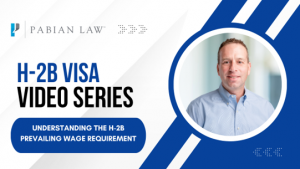
This week’s video: Understanding the H-2B Prevailing Wage Requirement
This week’s video is posted (linked)! One of the most important compliance obligations in the H-2B visa program is ensuring that workers are paid at least the required Prevailing Wage. Yet many employers find the prevailing wage process confusing and are left wondering how these wage rates are determined and what they mean for their business. In this video, we break down the H-2B prevailing wage requirement in clear, practical terms. You’ll learn how prevailing wages are calculated, why they vary by occupation and location, and what employers need to know to remain compliant while effectively planning their workforce and labor costs. Whether you are new to the H-2B program or a seasoned employer, this video will help demystify one of the most critical aspects of a successful H-2B petition. For more H-2B visa updates, best practices, and immigration insights for hospitality, tourism, landscaping, seafood, and other seasonal employers, subscribe to Pabian Law’s channel and turn on notifications so you never miss an episode.#H2B #H2BVisa #SeasonalStaffing #HospitalityIndustry #ImmigrationLaw #WorkforceSolutions #PabianLaw
We hope that you find these resources helpful as we all try to make sense of what is really happening in the world of immigration law.
Thanks, everyone, and have a great weekend!
Best regards,
Keith and the Pabian Law Team